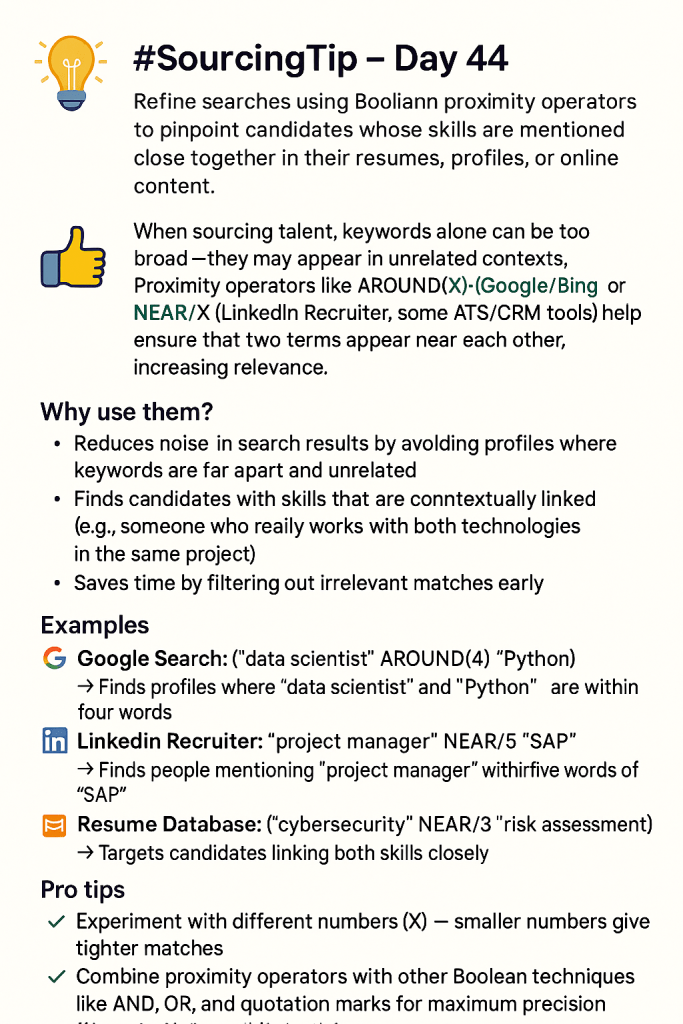
#SourcingTip – Day 44 🔍Refine searches using Boolean proximity operators to pinpoint candidates whose skills are mentioned close together in their resumes, profiles, or online content. 💻When sourcing talent, keywords […]
#SourcingTip – Day 44
🔍Refine searches using Boolean proximity operators to pinpoint candidates whose skills are mentioned close together in their resumes, profiles, or online content.
💻When sourcing talent, keywords alone can be too broad — they may appear in unrelated contexts.
Proximity operators like AROUND(X) (Google/Bing) or NEAR/X (LinkedIn Recruiter, some ATS/CRM tools) help ensure that two terms appear near each other, increasing relevance.
💡Why use them?
✅Reduces noise in search results by avoiding profiles where keywords are far apart and unrelated.
✅Finds candidates with skills that are contextually linked (e.g., someone who really works with both technologies in the same project).
✅Saves time by filtering out irrelevant matches early.
How it works:
AROUND(X) → In Google/Bing, finds results where two terms appear within X words of each other.
NEAR/X → In LinkedIn Recruiter and some databases, works similarly but uses “NEAR” instead of “AROUND”.
Examples:
Google Search: (“data scientist” AROUND(4) “Python”) → Finds profiles where “data scientist” and “Python” are within four words.
🔗LinkedIn Recruiter: “project manager” NEAR/5 “SAP” → Finds people mentioning “project manager” within five words of “SAP”.
Experiment with different numbers (X) — smaller numbers give tighter matches.
Combine proximity operators with other Boolean techniques like AND, OR, and quotation marks for maximum precision.
Works especially well for niche tech stacks, combined certifications, or specialized domain expertise.
✅ Example use case: If you need a “Java developer” with “Spring Boot,” searching for “Java” AROUND(3) “Spring Boot” helps you find profiles where both skills are mentioned together in job descriptions or project work, instead of scattered across the resume.
Myself Manish Pipalwa, an HR Professional with with more than 9+ years of Experience in Recruitment & Sourcing.
Currently employed with Eaton Corporation as Talent Acquisition Consultant- Supporting Hiring for 2 Major Business Units Relating to Finance & Supply Chain Domin.
Prior to Eaton, was associated with Mphasis as Assistant Manager- Talent Acquisition.
My Interest are Networking , Travelling and in Social Media




 sourcingspider

 SourcingSpider