
#HR Word : #Compensation Carve Out
A compensation carve-out refers to the policy of keeping away a portion of the increase in compensation budget for the highest performing employees. This carve-out approach impacts various points in the […]
 SourcingSpider
The Web is Webbed..

Simplifying HR Jargons
A compensation carve-out refers to the policy of keeping away a portion of the increase in compensation budget for the highest performing employees. This carve-out approach impacts various points in the […]

Compensable factors can be simply understood as the criteria used to evaluate a job and on the basis of which salary/wages of the employee is computed. It is like the […]

Comparable Worth A wage system based on the idea of comparable worth ensures that wages are determined based on the ‘worth’ of jobs and the tasks they entail (which in […]

Definition: Compa-ratio A compa-ratio of ‘100 %’ would mean that the employee’s current salary for a job position and the range mid-point for a comparable position are equal. Compa-ratio= […]

Definition: Collective Laissez-Faire Collective Laissez-Faire is the system by which power is given in the hands of the employees & trade unions by which they can freely negotiate among one […]

Collective conciliation brings the parties (employer and trade union) to negotiating table, to negotiate and discuss any issues or disputes. The person from third party is called as conciliation officer. […]

Cognitive dissonance is the feeling of discomfort on holding contradictory cognitions or different ideas in the mind simultaneously. Cognitive dissonance results in tension often when what a person believes is […]

Closed Gestures are negative form of body language where a person appears to be protecting their body and not willing to communicate honestly and completely. Gestures are a form of non-verbal […]
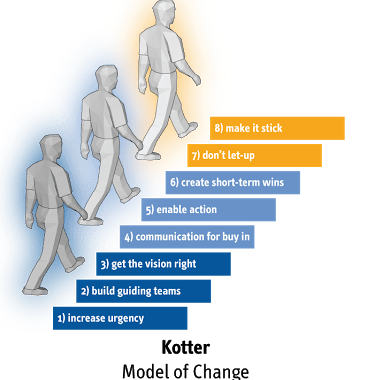
Kotter suggested a change model consisting of 8 steps. The purpose of the model was to enable change in the right manner to create value and to ensure that change […]
The change management iceberg suggested by Wilfried Kruger emphasizes that manager mainly consider the hard issues for change i.e. cost, quality and time. These issues represent only the tip of iceberg i.e. only about 10% of the total issues. Most of the issues – soft issues – are below the surface. Change affects 4 types of people in the organization: […]

A change agent is a person from within the organization or brought in as an outside consultant who helps bring about organizational transformation through focus on organizational effectiveness, improvement, and […]

Central tendency is the inclination of managers to rate all their subordinates with an “average” score during performance appraisal. For instance, if the rating scale was from 1-7, the managers […]

Cell production is a form of team work where the entire process of production is split into small groups called cells. Each cell is responsible for a complete unit of […]

Casualization is basically defined as the change of the workplace, having predominantly temporary workers rather than the permanent workers. It is predominantly caused by the forces of supply & demand. […]

The case study is a method used as a part of, off-the-job managerial training and development. It includes a detailed written description of a stimulated or real life decision making […]
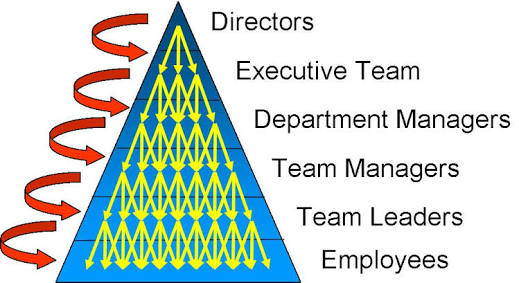
Definition: Cascade Communication Cascade communication means passing of messages or information from senior executives to junior executives to managers. Those managers then pass on this message to other employees directly […]
 SourcingSpider